Showing posts with label Major Topic --- Arts --- Brainstorms. Show all posts

Saturday, August 22, 2026

A launch pad located on the moon

8/22/26:

The calculations were a bit foolish of me to post. It's embarrassing. I'm not trained in the physics, obviously.

Nevertheless, one does not need to know too much about it in order to see that that delta-v from the lunar surface to lunar orbit is rather low in comparison to Earth.

The lunar lander during the Apollo Era used about half the wet mass of vehicle in order to touch down on the surface. Thus, if the lander masses at about 35,000 lbs, then the mass on the surface would be 17,500 approx.

Likewise, the return to lunar orbit requires that the vehicle have approx 1/2 of its mass as propellant.

In the case of the lunar modules ascent stage, that was about 10k for the upper part of the LEM, for a propellant load requirement of about 5k lbs.

Using different propellants would change the numbers a bit, but it's a good approximation. That is, unless you start doing things like the Parkin concept. Then it would require much less propellant to get to lunar orbit. That's because the ISP would be comparable to a nuclear thermal rocket, which was around 900.

It makes a lot of sense to use the moon as a waystation on the journey to Mars. Perhaps that's why Elon Musk is going to go to the moon.

Of course, that means a lot of preparation first.

11/14/12: The original post follows:

Fiddling around with idea to use beamed energy to get a lander/ascender to/from the lunar surface.  It would be about the size of the lunar module from the Apollo Era.  To guide me in the calculations, I used the link below:

Here's a link to calculate the energy

Potential energy (PE) is just weight multiplied by distance upward; this is the same weight multiplied by distance upward, which is the same as mass multiplied by acceleration of gravity, multiplied by distance:

PE = w * h = m * g * h
g for earth is about 6 times that of the moon
g for moon is 1.622 meters/sec2
 Kinetic energy is just half the mass, multiplied by the square of the velocity:

KE = ½ * m * v2
calculations for 100 km above moon:

PE = (1 kg) x (100,000 m) x ( 1.622 meters/sec2 ) equal 162200 joules
KE for escape velocity moon 2.38 km/s equal 5664400 joules
KE for 2/3 escape velocity 1271375 joules, added together to get total energy required:  equal 1,433,575 joules

A Kilowatt-Hour is 1000 Watts for one hour, which is 1000 Joules per second for 3600 seconds, or 3.6 million Joules.

Therefore to roughly approximate, to launch 1 kg in lunar orbit at 100 km is equal to   1,433,575 joules /   3,600,000  Joules or about 0.4 kilowatt hour per kg.

That equals 1810 kilowatt hours energy for lunar orbit approximately for a mass about the size of the lunar module ascent stage which was 10000 pounds or 4500 kg.

Now guessing that to deliver 20 megawatt/hr of power for .1 hr or 6 minutes would be enough energy to get to lunar orbit--- to deliver that much energy would require 200 fuel cell units that could deliver 100 kilowatts each.

The idea here is to use Parkin's concept of microwave beam energy to land and take off from the moon.  It would have a performance ISP equal to a nuclear thermal rocket, about 850 sec., which would save mass in landing and taking off.  You would have to have a fuel supply on hand for taking off, of course.  Having the fuel depot located on the moon obviates the need to bring the landing fuel with you, simplifying matters greatly.

To execute this idea, you would need a crash landing trajectory that would be interrupted by the beamed energy to slow the spacecraft down to a soft landing.  That is to say, there would be no orbiting first.  That would require even more energy than the calculations above--- but not too much more.

You would place a microwave unit on the moon with an energy source to run it.  The energy would be beamed to the incoming lander as it gets into range.  You would have to slow down from about 5000k mph to zero in less than a few minutes ( without doing the calculations).  That's true because the beam may not have a range more than say 150 miles.  At 5000k mph, you will cover that distance quickly.

Taking off, just reverse the process.  After filling up the fuel tank of course.

The next question is: how big must the microwave unit(s) be to deliver say 30 Megawatts of power?  The current guess is that you could deliver these microwave dishes in a number of landings to a yet to be determined location on the lunar surface.  Each unit itself would be about the size of the lunar lander in the Apollo Era.  The microwave dish would be on top instead of the ascent stage.  Each dish would be an integrated unit complete with power source.

How many dishes to deliver the required power?

The rest of the topic is for later discussion.

Update:

You may need multiple launches of a the new big ass rocket being developed for a pretty penny.
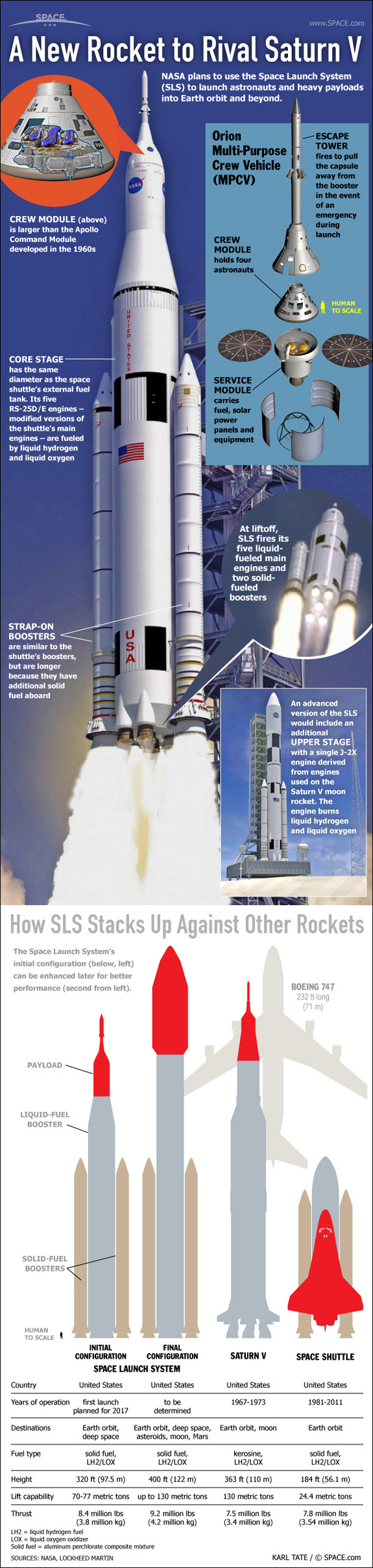

See how NASA's new mega rocket, the Space Launch System, measures up for deep space missions in this SPACE.com infographic.
Source: SPACE.com: All about our solar system, outer space and exploration

Falcon XX would have lift capacity equivalent to Saturn V or new SLS rocket
Or, you could use SpaceX's new family of Super Heavy Lifters.

Tuesday, August 11, 2026

Getting rocket fuel into orbital space depots

8/11/26:

Well, it certainly appears that something has changed up here. None of these ideas will ever matter at all since SpaceX's Starship will be able to take over 100 Tons to orbit soon. Fuel depots are in the mix for the Starship, and if that works out, other ideas can't compete.

The thing about JP Aerospace is that you may be able to use it on Mars. On Mars, the atmosphere is already as thin as Earth's at the altitude that JP wants to use the ascender for. The ascender will go to orbit. It is a matter of how much energy it needs and whether or not it will be enough to get to orbit. Mars gravity is roughly 40% of Earth's, so if orbital velocity is also 40%, that would make it about Mach 10? (I could ask AI for that number, and probably already have once. If so, I may update this later.)

Ascender can be used on the Martian surface for sure as a transportation system to any other place on the Martian surface even if it cannot get to orbit (yet).

Gas guns? John Hunter of Quicklaunch once mentioned that you don't even need to heat the hydrogen gas in order to get to lunar orbital velocity! Think of the possibilities.

12/16/12: The original post follows:

Speculation alert
MAB post 11


John Powell of JP Aerospace wants to get up to orbit with an airship.  John Hunter wants to use an air gun to get fuel up to orbit.  Now, this may be a crazy concept, but here goes.  Combine the two by sending 100 lb payloads to orbit from JP Aerospace's Dark Sky Station.

Hunter says he can do 10 shots per day.  That would be a 1000 lbs per day.  After a month, you have a respectable amount of fuel in orbit.

Another purpose for using the Dark Sky Station this way is to avoid the energy loss of going through the lower atmosphere at high velocity.  This enables a smaller gun to do a bigger job.

As I noted earlier, you can't put a gas gun on a plane.  You can't even put a gas gun on an Ascender.  But you can assemble one in a Dark Sky Station because the Station is frickin' huge.

Getting the gun there is only half the problem, though.  Maybe the easier half.  The other half is what to do about the recoil of the gas gun?  It will be too much for the Dark Sky Station to handle.

One thing that could be considered is to capture the energy of the recoil and use it to make work.  That work will act as the buffer that will soften the recoil of the gas gun.

How to do that? The old 64K dollar question.

You could use the energy to spin up one or more flywheels.  A flywheel with enough mass and capability to spin at great velocity.

Update:

As long as this is a speculative post, let's use the MAB concept in concert with this concept.  The MAB would take it to orbit.  The Hunter gas gun would give it a boost to 1/2 orbital velocity.  The total wet mass calculated assuming 20% payload fraction ( Parkins assumption) gives us a vehicle of under 1k lbs.


Wet mass for 100 lb payload launched from DSS/MAB assuming 20% mass fraction (MAB module)

What to do about that recoil?  Use the Airship to Orbit module launched from the Dark Sky Station for your launch pad.  Point it in the direction so that the recoil forces the Airship down.  The buoyancy of the Airship will force it to come back up.  You could also dampen the recoil a bit as described above.

The gas gun would have a smaller payload than what Hunter is talking about.  But the extra mass brings it back up to full size.  That's much too big again.  So, we pare down the size of the gas gun by making it less ambitious.  It will only go 1/2 orbital velocity.  A conventional rocket will take it to orbital velocity from there.

Still worried about the recoil.


Monday, July 27, 2026

Mining that 20 trillion dollar rock in space ( mining an asteroid part XXVIII)

7/27/26:

Much is made of Elon Musk's wealth, or any other rich person. But what is wealth but the relative lack of some good thing? If everything becomes abundant, then what would be wealth? Then, it would be hard to be envious when there is nothing good that is in short supply. Envy is an odd thing. It may matter more to the envious that you don't have a thing, than for the envious one to have it himself. Envious people seem more worried about people having things than in people not having things.

8/16/15:

Previous

One of the ideas I had was along the line indicated by the title of this post.

When I left off with that series, I came up with an idea of using an Iron Man suit for life support.  This suit would reduce the weight requirements, as the shielding would only cover the human body, which is much smaller than an entire spacecraft.  You could get pretty good shielding for relatively little weight.

Now, another idea popped up.  Instead of using a space sail, use a VASIMIR concept.  This would require a large solar array, which could be built like the solar sail mentioned in the series.  This would be much, much smaller in scope, however, and therefore, much easier to build.  You could build one that would capture up to 90% of the heat energy being lost, and then recycle it again and again in order to give a multiplier effect.

Let's say you can recycle 90% of the energy lost through heat.

After one pass through, you've got 90% left.  The second would have 90% of the 90%.  The third would have 90% of the 81%, and so on and so on.

So, and equation could be derived from this relation:

x+ .9x + .81x + .729x +  0.6561x + 0.59049x + 0.531441x +  0.4782969x + 0.43046721x+0.387420489x+0.3486784401x+0.31381059609x+0.282429536481x+0.2541865828329x+0.2287679245496x+0.205891132094649x+0.1853020188851841x+0.16677181699666569x+0.150094635296999121x+0.1350851717672992089x+0.12157665459056928801x+0.109418989131512359209x, which equal to approx 9 times.

Thats about 10 times x minus 1.  If y is the percentage amount remaining after one pass through, then, we obtain the generalized equation 1/y, where y is less than 1.  Thus, 1/.9 equals 9.

You would layer some thermoelectric devices around it and pass the coolant through enough layers to obtain the amount that would be recycled.  If the coolant is a gas, it would have to pass through several layers, grabbing off a piece at each layer.  If it were a molten-salt, it would grab off a piece, then shunt the liquid to the next layer to be utilized with the layered thermoelectric devices until the cooling down is complete.  You could have many, many layers.  In space, this may present difficulties as there is no gravity.  You could spin the device, and that would shunt the materials through each layer.

Therefore, with a solar electric array that generated 1 megawatt of power, you could multiply that by 9 in order to get 9 megawatts of power.  This could get a vehicle to Mars in a relatively short time.

But you could also get to that asteroid you are trying to mine.  Maybe you could start with Deimos.

Update:

A possible better idea for a thruster?  It is a continuation of this discussion on to the next post.  I wanted to link these together.


Tuesday, April 1, 2025

Solve for X: Rob McGinnis on global water scarcity ( reposted from 2012)

4/1/25, 9:37 AM :

This was a long time ago, so it may take a bit of digging to find out more. Basically, he sold his tech to a Chinese group! The Chinese couldn't make anything out of it, so they went belly up. Not sure where the story went from there, but still looking...


10:26 AM:


Leo AI doesn't seem to know much about it. A few clicks through what's out there seems to show that this is a very complex topic with no one-size-fits-all type of solution. Still looking.

UK's Modern Water is another name mentioned. However, there's nothing all that new being mentioned on this website.

11:00 AM:


Here's one of the more recent videos of Rob McGinnis. Why would I be interested in this greenie weenie stuff? If it makes sense economically, then there's no need for draconian regulations to put it into large scale practice. But get this: It might make sense on Mars. Guess who's going to Mars?


3/31/25:

The original post seems to have gone missing, but there's this copy. So I am wondering: Whatever happened with this tech? It would sure come in handy, you know?


Featured in this video:


The url of the post that forms the basis of this question:


Solve for X


So, I found the post again, and I'm reproducing it yet again for future reference. I've used the IDEA for some of my ideas about energy. The smelling salts are produced the same way, and can be a way to move the hydrogen from place to place. You need to make the hydrogen and then combine it with nitrogen in order to get the ammonia. Ammonia is toxic, so making it into smelling salts makes it harmless. ( until you release the ammonia )

If you release the ammonia in small amounts, then you will limit the damage it could do, you see? Therefore, you could store the smelling salts indefinitely, and then when you want the ammonia, it can be recovered easily.


12/29/16: note:

Smelling salts can desalinate water and be a source of ammonia for a fuel cell, that produces even more water and electricity.

Now all you need is to separate the ammonia from the carbon dioxide.  There's a way...

the original post follows immediately...


Update:

Some background info from Business Week.

Friday, December 13, 2024

Elements of a gas harvesting mode (Loxleo)

12/13/24:


To be continued on the second blog.


12/12/24:


What might be done with Artemis II?


Indeed, what is to become of the SLS now that Trump is coming back into office?


This post is about something that isn't entirely inconceivable, as it had been previously researched.  It may be considered too ambitious, even at this stage of SpaceX's advanced rocketry. It would also seem that in situ resourcing on the moon could be considered too ambitious.


But if goals like these are too ambitious, then how is landing on Mars any less so? Just asking question is all.


Quick update:  Perhaps no less ambitious than this.


  11/22/24:


Here's a kind of brainstorming session, which will combine a few concepts into a plausible way to harvest gases at the edge of space. This is called Loxleo ( liquid oxygen at low earth orbit --- don't you love these acronyms?).


I've done this before, and as before this will include a speculation alert.


The elements include the use of Parkins concept in his doctoral thesis in order to get a high ISP propulsion with a lot of delta-v, saving a lot of fuel. The energy will be supplied by the use of solar panels posted at GEO. There would have to be an array of these panels, which would include all of the necessary hardware to beam the microwave energy down to an orbiting aeroshell that is on the edge of space, in very low orbit. The solar panels at the edge of space comes from a concept in the book Mining The Sky. The author, John S. Lewis suggested that this was a way to get the space program on a paying basis. You could manufacture the solar panels on the moon, and send them back to GEO in order to make some money for the lunar base.


As could be seen on those spectacular videos of Starship's re-entries, there's plenty of atmosphere that could be gathered up. It is also creating a lot of friction on the Starship, which causes it to lose velocity. If you add a gas harvester, it will create even more drag. In order to keep the Starship up in space, you need to fire up some sort of engine that will keep up the delta-v at orbital levels. So the microwave energy is beamed down from GEO, and it heats up an aeroshell. From there, cold gases are injected to cool down the aeroshell, as the Parkins concept showed. The gases would be ejected out a nozzle, thus creating thrust. The ISP that might be achievable could be comparable to a nuclear thermal rocket. More than twice that of the best chemical engines.


The Loxleo concept itself was an idea that orginated back in the sixties. ( or possibly sooner) That concept included nuclear thermal engines to keep the vehicle up to orbital speed. The concept's weakness was in how to get energy to the thruster. A nuclear reactor in orbit tended to make people nervous.


Perhaps the harvested gases themselves could supply some, or perhaps all of the reaction mass that will provide the thrust. The trick would be to harvest it faster than it would be used up! It just won't do to end up with less mass than what you started with. The atmosphere consists of oxygen, nitrogen, and argon. The argon is only about 1% of the atmosphere, so you may have to mix some nitrogen in there with it. The most valuable resource could well be the oxygen. Hence the name, "loxleo". You'd want to keep all of that you could gather. Argon, by the way, is a noble gas--which means it doesn't react with other elements very easily or at all.


The advantage of loxleo is to reduce the number of launches from the deep gravity well of Earth. Oxygen would provide as much as 80% of the reaction mass to run the Raptor engines. In order to refill the Starship, it will be necessary to launch multiple times from the ground. The advantage should be obvious if you could make loxleo work. It is in situ resourcing, which is better than bringing everything you need from home.

Wednesday, September 22, 2021

Deliverance from the Dead Zone. ( repost )

Update:


There appears to be a new angle to this idea.
It involves replacing plastics with algae.

The original post follows:

10.21.13:

Note:
 In connection with a space mirror, the output from this proposition could be increased significantly.  Use the profits from the sale of drop in fuels in order to expand the enterprise.

....

What's with the title?  What's this Dead Zone stuff, an allusion to a Steven King novel?  Throw in the reference to the Burt Reynolds movie and it looks like a double ripoff.  Yeah, well I have to do something to get your attention.  Very funny.  Ha, ha.  Funnier than a barrel of Congresscritters.

Actually, the title is reference to The Gulf of Mexico Dead Zone --- where nothing lives.  The Deliverance part is a proposed solution that is a speculation alert.  Why?  Because I don't know if it will work, or even if it could work, whether or not our corrupt system will actually allow a solution to a problem to be implemented.

The idea is to grow seaweed in the Dead Zone.  Harvest the seaweed and make biofuels out of it.  Eventually, the drop-in biofuels could be converted to hydrogen for fuel cells.  You kill two birds with one stone.  Eliminate the Dead Zone and lick the global warming "problem".  Throw in energy security as a bonus.  What's not to like?  Heck, you could create a lot of jobs and economic growth with this.  Only a Congresscritter could hate it.

Let's look at the Gulf shall we?  First of all, consider its typography---depth of the Gulf of Mexico.  The Dead Zone lies directly offshore on the shallow shelf area.  A good place to put something there if it requires a shallow body of water.  Here's some more info on Gulf of Mexico pollution via Wikipedia.  I figured that since algae already grows there in this Dead Zone, you could substitute the seaweed and force the red tide out of the picture.  Voila!  End of red tides and the Dead Zone.

You would need a massive public works project to implement the idea.  The shelf areas of the Gulf are probably not conducive to the growth of seaweed, so you may have to add something to the shelf that the seaweed can attach to.  That is, seaweed clings to rocks, but the bottom of the Gulf is sandy.  Replace the sand with rocks or something else, like chicken wire perhaps?

You could start small and work your way up.  Perhaps the 8000 square mile area could be divvied up amongst entrepreneurs parcel-by-parcel until the entire Dead Zone is covered in seaweed farms.

This isn't necessarily a novel idea.  They do a lot of this in Asia, as noted in an earlier post.  Here's a few links on the subject that I "dredged up" ( pardon the pun) on the subject.


Monday, January 28, 2019

Burial idea

Reposted:

1.28.19:

It was nearly two years ago to this day that I went into the hospital.  Evidently, something was on my mind at the time.  ( a bit of irony there )

Well, I am still around after two years, and I was looking back at that time again in order to find the exact date that I went into the hospital.  I found this post, and it seemed to be worth posting again.

You know what?  It might cost a huge amount, but if I could, this could be my final wish...

Scatter one's own ashes?  No.  But to make a cast out ones own bones may not be such a bad idea.  Wonder if it could work?

These days, it seems like you can get cremation for a fairly low price.  However, my understanding is that all that is left are bones, not ashes.  Now, if the bones were to be subjected to enough heat, the results would be quicklime.  If enough quicklime could be obtained, it could be applied onto a facial mask made before death.

Anyway, it is an idea...

Original post on 1.24.17:

The funeral business seems lucrative, perhaps even an opportunity exists provided that you could come up with an innovative idea.  This may not be innovative, but it does have some elements to it that may not have been done before.

The Malta Treatment liquefies the soft tissues leaving only the bones.  The bones can be ground down to a powder resembling ashes.  Here's what may be possible:  the bones are primarily made of calcium carbonate, the same stuff as limestone.  When this is heated enough, the carbon dioxide leaves, which gives quicklime.  The quicklime can be reconstituted back into limestone with the addition of water.  In other words, the process is a closed loop.  The idea is to fashion a bust of the deceased person, and cast it in concrete made from a deceased person's own ashes.  The liquefied part can be stored inside of the bust.  The body is still there, but has taken a different form: a form that would be recognizable to the survivors of the deceased.

The departed could be visited.  It is better than a grave, which keeps the deceased person out of sight.  The body is respected, which should allay religious concerns.  It is technically feasible, more than likely.  It could add another option to the choices available for one when that inevitable moment comes for us all.  It would last for generations, perhaps even centuries.  Future generations could trace back their ancestries in a more lifelike way.  You could see what your ancestor looked like.

The idea could be expanded further with high tech enhancements.  For example, artificial intelligence could mimic a person's personality.  You could "talk" to the dearly departed.

You know what?  This could work.  Particularly if the price is right.


Friday, July 13, 2018

Will Ultracapacitors Overtake Batteries in the Energy-Storage Race?

Will Ultracapacitors Overtake Batteries in the Energy-Storage Race?: The short answer to the headline’s question is probably not. Perhaps this isn’t the answer you were expecting from the CEO of an ultracapacitor manufacturer. However, ultracapacitors and batteries are different technologies with different benefits for different applications. The idea a battle exists between the two is perhaps a bit of an energy-storage myth.

comment:

An intriguing possibility is the use of ultracapacitors with fuel cells and batteries.

I have seen on the web, fuel cell cars with ultracapacitors, but not with batteries.  Why suggest this combination?

If batteries are used without fuel cells, then it doesn't allow you to downsize the battery very much.   Likewise, if you don't use batteries, but just fuel cells, then you need more powerful fuel cells.

Battery size and fuel cell size can be optimized, I would think.  With optimization, costs would also be optimized.  A bigger battery is a more expensive proposition.  With a small fuel cell, costs could also be optimized.  The final costs could be competitive with ICE powered cars.

As for the fuel, you can make nuclear ammonia as the hydrogen carrier.  An ammonia infrastructure already exists.  Ammonia could be taken to the point of sale, and hydrogen could be obtained from the ammonia.  This may be accomplished with little need for additional infrastructure, and costs would be competitive with fossil fuels.


Monday, January 8, 2018

Nuclear powered airships

Updated:
Originally post many moons ago ( 9.23.12)

Updated 1.8.18:

Want to force the Norks to quit?  Show them that we can shoot down anything that they aim at us.

With this idea, we can convince them to give it up.

But we can do a whole lot more...  Just have to have the will to do it.

the original post follows:

Speculation alert.

Another brainstorm here.  Kirk Sorensen didn't like the nuclear aircraft idea.  But what if you used an airship instead?  You wouldn't have to support the weight of the reactor with aerodynamic lift, but would supply it with lift from the airship itself.

These airships are said to be quite capable of lifting heavy stuff.  I tried to get an idea of how much and if it would be enough to put a reactor on-board.  If you could get a reactor on an airship, the thing could fly indefinitely.  The only time you'd have to come down would be for resupply of the people-- not fuel as in conventional aircraft.  They could work like nuclear aircraft carriers or subs.

Instead of using light water reactors, you could use molten salt reactors.

The buoyancy of the airship would give you time to restart a reactor if needed, or go to a backup source of power until you could power up again.

It would have all the advantages mentioned for molten salt reactors, such as inherent safety of these types of reactors, proliferation resistance, and waste reduction.

What would you do with this thing if you had it?

Good question.

Intelligence gathering would appear to be one use.

Transportation to almost any location on Earth is another.  High altitudes may be out, but perhaps the thing could lift itself to very high altitudes.  If that is possible, it may also be possible to speed up to high speeds because wind resistance would be much less at higher altitudes.

Here's another idea:  Put an Airborne Laser-- not the plane, but the laser--- on one of these things.  It could shoot down anything that came against it.


Saturday, June 3, 2017

X37-C plus Stratolauncher plus NTR upper stage ends "Pony Express" Era of Spaceflight ... updated 6.3.17

Updated on 6.2.17, originally posted 1.4.14:

Note:  The Stratolauncher rolled out of its hanger the other day.  However, the rest of this post is a lot of fantasy.

Which is why I started my own "moonshot".  No fantasy, no fakery, but something real that I could do myself.

Little did I realize how big of a challenge that that would turn out to be.

update to the update:  Come to think of it, Elon Musk was once a part of this project.  Since that time to this, Musk has perfected his technology of landing a first stage rocket after finishing its burn.  Now, if he had stayed with the Stratolauncher program, would they have had a 100 per cent reusable system?  No, Musk still needs a reusable second stage.

Fast turnaround?  Musk hasn't done that yet.  But he probably figured he didn't need the Stratolauncher anyway.  He may well be right.


6.3.17, 10:00 :  


If the Sabre Engine, under development by Reaction Engines of the UK, can be mated with the X-37C, it may get to orbit without an NTR, and return with the all of the components being reusable.  The biggest component, the airframe that lifts off the ground, is almost ready to fly now.  A thought, anyway.


The original post follows:

I'll make a series out of this one.  The first was the X-37C post, made on September 11th.  The second post was a brief followup last month.

An idea for this post came from how the XCOR's Lynx will get to the Karman line.  It will fire its engines and get only to Mach 3, and then drift upwards to the Karman line before returning to the ground.  The idea here is to get to the Karman line with some momentum and let the NTR do the rest of the lifting to orbit.

It has occurred to me that the mass of the X-37C is close to the mass envisioned in James Dewar's book "The Nuclear Rocket".  Let's say we want to replace his idea of using solid rocket boosters to be launched from a cargo plane--- with a launch from a Stratolauncher and an airbreather engine like the SABRE engine being developed for the Skylon SSTO.

This warrants another speculation alert, of course.

Dewar wanted his package to mass out at 91k lbs.  Presumably, this would be a 17k pound payload into orbit.  That's pretty close to the X-37C's mass.  I didn't see any provision in Dewar's concept that would save the hydrogen tank.  We should want to be able to do that.

The SABRE engines wouldn't be required to go to orbit, so we could economize on mass there by making that booster smaller.  It won't be needing oxygen tanks since it is only going to be used in its airbreathing mode.  The Stratolauncher helps save mass here too, because it imparts the first 30k feet of altitude to the orbiter.

Instead of going to orbit, the SABRE engines would separate at Mach 5.5 and 85k altitude, thus imparting momentum to the 91k mass of Dewar's NTR module.  The module would drift upwards to the Karman line or possibly well below it and then light up the nuke booster.  The SABRE powered booster would do a RTLS (return to launch site ).  The 91k NTR's mass could probably be increased, since the airbreathing booster would not have to carry oxygen.  The downside is that the NTR would be losing momentum as it waits for the nukes to warm up.

You could play around with the masses in order to optimize the design so that it will make it all fully reusable with a fast turnaround.  For example, instead of a "cocoon" that enables the nuclear core to be fished out of the ocean, some landing gear could be supplied so that it can land like a plane.  Also, the tank could be made into a lifting body shape and designed so as to survive a reentry.  If more mass is needed, you may have some margin in the concept for that.  Up to 500k pounds could be lifted by the Stratolauncher.

I'm thinking that it should be optimized so that that you don't have to use onboard oxygen for the first stage ascent.  The SABRE provides that capability.  The second stage on up to orbit would use the higher ISP capability of a nuclear thermal rocket (NTR)--- up to 1000 ISP.

Hopefully, there is a design that would enable all these advantages to be incorporated in a practical design that could be fully reusable and with a fast turnaround.  The launch costs could be brought down so as to make space more accessible.  That's what James Dewar believes the NTR can do.  Dewar compared the chemical rocket to the "Pony Express".  A nuclear rocket could take us to the next level.

Update:

Running the numbers seems to confirm that this could work.  As for the rest, it would have to fit under the wing of the Stratolauncher and it would have to pass through all the red tape.

Update:

The entire mass of the thing except the X37-C and booster, could fit on a X33 airframe.  You'd have to mate the NTR booster on to that, but if you could, the thing would mass at less than the X33 launcher originally planned.

The X33 failed because of the large hydrogen tanks, but those would be much reduced by an airbreathing engine for most of the trip.  The X33 was a demonstrator only, not designed for orbital velocity, but suborbital velocities and altitude mentioned here.

The X33 would have to be redesigned for this, though.  The imagination runs a bit too freely, perhaps.

Update:

After crunching the numbers even further, I am beginning to wonder if you even need the Stratolauncher.  You may be able to use a 747 in the same way that it was used to transport the Shuttle.  In addition, all of the fuel should fit inside the X-33 fuselage so that it can be made into a cargo holder for the NTR.  This configuration would allow the same X-33 airframe to house the NTR/X-37C and be lifted by a 747.  A minimum of new stuff would have to be invented.

next


Friday, December 30, 2016

A comprehensive system? Maybe.

This post will fit into my  off-the-grid series of posts.  It will be classified under the general subcategory, or subseries.  It can read end to end by following the links, or the entire series can be accessed through the table of contents post.

Prev   Next

I want to tie together a few posts in order to show how this can fit together into a neat plan.

First of all, the last few posts show how one can transport hydrogen safely from one spot to another with a solid material, such as smelling salts.  Smelling salts are relatively safe, certainly safer than fossil fuels, if you want to compare.  Also safer than transporting plain old ammonia.

You can also use the smelling salts to obtain fresh water, or to recycle dirty water.  My plan is to use only five gallons of water daily, of which I wish to keep at least fifty percent of it, so as to only need to replace it with a couple gallons of fresh water daily.  This is obtainable from a fuel cell system that could be purchased from a company I contacted not that long ago.

Sure, you can make hydrogen out of smelling salts.  But you still need the ammonia to make the smelling salts.  You can get that from a nuclear power source, such as a molten salt reactor.

A plant to make smelling salts using a molten salt reactor could be a killer app for both fuel cell cars and molten salt reactors.

A thought for the night!

As for me, I'd like my own little moonshot to work, but I have to get well first.

That's a whole 'nother problem.


Thursday, December 29, 2016

Back of the envelope calc for fuel cell production

Let's say you had a fuel cell that could produce 3.5 kwh continuously.  If you ran it for five hours, that would produce 17.5 kwh of power.  Plenty enough to run a household.

The amount of hydrogen needed for that could be about a kilogram.  The reason for that assumption is that a fuel cell vehicle can get about 60 miles on a kilogram of hydrogen.

An electric car can go about 4 miles on a kwh of electricity.  For a Tesla, that's about 50 kwh for a vehicle for 200 mile range.

So, roughly about the same as above: 15 kwh of electricity gets you about as much as a kilogram of hydrogen from a fuel cell.

So, the above fuel cell could use about one kilogram, as stated.

It takes about nine kilograms of water to produce the hydrogen for one kilogram hydrogen.

That's about twenty pounds of water, or about two and half gallons of water.  The fuel cell would produce not only electricity, but two and a half gallons of drinking quality water.

Now for the interesting part:  It would take about one and a third pounds of smelling salts to yield a pound of water.  That means that twenty pound of water would require about twenty six or a little more of smelling salts.

The smelling salts could be broken down to ammonia and carbon dioxide.  The ammonia can break down to hydrogen for the fuel cell.

The tech exists that could do all that.  Economics?  Not sure, but there's an outfit that can make the ammonia cracker and of course there's companies that make smelling salts.  The last piece is to collect the ammonia from the smelling salts.

I think it is all feasible.


Saturday, April 23, 2016

Coffin plus trailer equals no septic tank

As can be noted, I am changing topics, as I have become quite disgusted with the political sausage making.  While I am controlling my disgust, I will move on to more pleasant topics to discuss.

Once the politicos finish screwing each other and us in the bargain, it may be useful to go back and examine the wreckage.

I am sure the politicos won't appreciate my labelling their activities as disgusting.  If they weren't disgusting, there wouldn't be as many problems, now would there?

My pageviews went down.  But of course!  People like the spectacle.  This author declines to participate at the moment.  I have other priorities than in dealing with a bunch of a-holes.

This post will fit into my  off-the-grid series of posts.  It will be classified under the general subcategory, or subseries.

Prev   Next


Problem:

Don't want to install a septic tank.  If an RV is available, suitably equipped, it can do for short periods of time.  Perhaps this keeps the regulators at bay for a period of time.  Want a sheltered place that can be climate controlled, and would allow me to stretch my legs without having to go outside into the elements.

Brainstorm:

An idea for using the trailer.  Make a box ( "coffin") that can fit on top of it.  Make a stand that it can sit upon on the property when the trailer isn't available.  Trailer can be put together and taken apart any number of times.  When not in use, can be stored in van, as it is now.

Procedure:

Fix it up so that the box can slide onto the stand, with a winch, and the trailer can be disassembled and taken with me.  Use the van to pull another trailer that can transport the car into town where I can earn a few bucks to make ends meet.  "Boondock" in town, and then return to the ranch.  Reassemble the trailer, and put the box back on top of it.  It is a portable RV.  When the box is on the stand, it's a storage shed. [ regulators will see shed when I'm gone, a small trailer RV when I'm on property]

Further details:

Will required detailed drawings and such in order to construct it properly.  Experience has shown that winging it won't work out too well.  Might want some help in the construction.

Note:

Said details would cause the next post to go into the construction subseries.  There was some confusion there that has to be cleared up.


Update:

Been double checking the links so that it works smoothly from one post to the next in the series.  I think the errors are out of there.


Sunday, January 17, 2016

Water collection idea, part 2

In part 1, I got the idea to make water condense on the outside of a container, like one can so often see on humid days here in Houston.  However, after running an experiment like that, I found that the water does not necessarily condense the way you want to.

It is necessary to lower the temperature of the air to the dew point where condensation will take place.  On the days that I tried this, humidity must have been low, which prevented the condensation to work the way that I had anticipated.

What if the air was more humid?  I was thinking to recycle the air that I exhale, and run it through a dehumidifier, which is nothing more than a condenser.  The water that comes out of the air is then kept, so I have always liked that idea for water collection, but the energy to run it is too high of a price.  What if I were to lower the price somehow?  Number one, I figured on trucking in some ice for my freezer, which I cannot really use out there, but it could be useful to use as an "icebox".  The "icebox" will keep perishables cold for a few days.  Why not use that ice for climate control, too?

But wait.  Shouldn't the water be cooler if it comes out of a dehumidifier?  If it were cool enough, the air could be directed over it and have a better chance at condensing since it is full of humidity from my nostrils.

Run the air by a heat exchanger before exhausting the air, and hopefully, the water in my breath will condense and can be collected.

The "dehumidifier" can use melted water from the freezer, which should be near freezing.  Air runs through some heat exchanger, and causes condensation.  ( I hope )  Perhaps the water could recirculate until it is too warm for cooling.  Each 18 lb bag of ice has the energy equivalent of 200 watt hours of heat energy.  Instead of paying for the dehumidifier, why not try using this energy instead?  That's a lot of energy to use for no other purpose than to keep food cold.  Let's make it work harder.

At the end of the day, I could have some condensed water, and the use of the ice for food preservation, climate control to boot.

This one goes into the water subseries of the off-the-grid main series of posts.

Prev    Next


Monday, January 11, 2016

water collection idea

Make water condense on chilled bottles with coils of chilled tubing wrapped around for maximal surface area.

Somehow, I will have to find a way to get those coils to stay in place.  Superglue, perhaps?  For the bottles, use bottled water containers.  For coils, use plastic tubing.  Glue them together and then freeze them.  Use anti freeze to get colder temperatures without freezing.  The colder it is, the better.  Has to stay below dew point before water will condense.  If it stays below freezing for hours, plenty of water should condense.

Additional possibility would be to place many such bottles on racks inside of a metal box.  The bottles will exchange heat with the racks and the walls of the metal box.  More surface area is obtained that way.

With my water experiments, I was able to gather some water this water from the humidifier. There will not be quite so much moisture in the atmosphere, though.

I can also use this cold box to set up another heat exchanger that will take the water through the radiator type device in order to make use of the colder air.  It will double as an air conditioner.

Update:

It may be a good idea to use metal screen in some fashion.  Seems to have a lot of surface area and would conduct heat well for the condensation desired.

This post will go into the water subseries of the off-the-grid main series of posts.

Prev  Next


Saturday, December 26, 2015

Rolling coffin

It's been awhile since I've written about my move out to west Texas.  With my increasing infirmities, I'm beginning to think that it may not be a good move after all.  As of this time, however, the move is still on.

One thing about the trailer, which I have already purchased, is that I wanted it to be tall enough inside so that I can stand in it.  However, that may create some problems in my plans.  The idea now may be to make it shorter so that I won't be able to stand up in it.  That said, it is somewhat reluctant of me to want to do this, because I don't like stooping inside the van.

But what purpose is the trailer, but to sleep in?  So, you don't need to stand up in order to sleep, but for to take a shower.  This isn't necessary either, as a shower can be set up so that you can do it sitting down.

The buildings on the property will be tall enough to stand up in.  When I'm on the go, it won't be possible to stand up.  Given the fact that I want to use the car for Uber, then I will need something to live in while in town.  This means the trailer.  This also means that the car will have to be stored in town while I drive back and forth between the property and town.  I can save money living in the trailer, but have to spend a little to have a storage space for the car.

It may be possible to do all that without busting the budget.

A shorter trailer then, is a possibility.  Also, a possibility to save money by making it myself.  Not to mention, I don't like the idea of towing a large trailer over those dirt roads out there.

When I discussed this trailer with my eldest brother ( number one ), he said this type of trailer is "rickety".  So, this was a bit discouraging for awhile until I came up with the idea to use cotter pins to hold the thing together.  Why not?  The only thing holding your front wheels on your car is a cotter pin.  That may bother some folks, but a tiny little piece of metal is the only thing that separates you from disaster.  If that cotter pin fails, the wheel falls off.  This is true, so it would also be true for holding that trailer together so that it will be more robust than what number one says.

If it has a lower profile, it will be easier to see around.  That important for driving around a lot.

For the actual building, the thought occurred to me to use a thin metal skin.  Actually, that isn't a new thought, as the idea of using metal has already occurred to me.  On this iteration of the idea, which may not be too different from the last, is to use the metal as a skin over the plywood and wood frame.

Another plus for the shorter profile is that it will be easier to climate control.  It gets closer to being the "coffin" that I described earlier.  The less cubic feet, the less energy it takes to keep it comfortable inside.  Call it the "rolling coffin".

Update:

Once again, I get the idea to use some of my stuff in the apartment for my RV van conversion.  The bedroom chest can fit snugly into the van.  I was thinking of cutting out a hole and placing a sink in it.  One 5 gallon bucket for fresh water, and one for grey water that collect the water going down the drink.  A mirror can be placed above it.  Plenty of room for one.  Not really a bad idea, especially if I am going to make the sleeping quarters in the trailer.

Update:

This entire concept may have to be shelved.  Too much expense.  Too much trouble.  It may be better to try something else.


This post will go in the construction subseries of the off-the-grid main series of posts.

Prev   Next


Sunday, December 20, 2015

Thoughts are ephemeral things


Thoughts are ephemeral things- here one instant, and gone
the next.  I wanted to hold on to two thoughts, but one
has slipped my mind, while I write about the other.

It had something to do with politics and the state of
the society.  Wish I could remember it.

The other is about science:

Does a particle passing by a body with a magnetic field
impart any force to that body?  If yes, how much?
And what is the nature of that force?

A thought experiment suggests that it does.  Consider two magnets.  They are supported on a cushion of air so that any force imposed upon them will cause them to move.  Maybe a bit like bumper cars.  On the other hand, maybe not.  Like Hovercraft, instead.  Anyway, the thing can float on air without touching anything that may cause friction.

Let's say you have a power magnet onboard two Hovercraft, and the two craft are heading towards each other head on.  The magnets are in front, so the two craft will come within their respective magnetic fields before they bump into one another.  What happens?  Most likely, the vehicles will be diverted somewhat by the strength of the magnetic fields interacting with each other.  Depending upon the strength of the magnetics and the amount of momentum each vehicle possesses, the collision might be averted entirely.

Now imagine if both are sitting still.  Advance one, while keeping the other still.  The likely outcome of this, I would think, is a pushing of one that's already moving of the one that isn't.  The other one will go away from the other ( provided that the magnetic fields are of the same polarity).

I think these two hypothetic scenarios show that some force is being applied to both objects.

The nature of the force that moves the stationary object is kinetic energy.  It is being transferred though the magnetic force, which is constant.  The kinetic force is variable.  Once it is removed, the source of the motion is also removed.

How can this be used for some purpose?

I was thinking of a space drive that enhances the effects of solar wind.  Since solar wind is charged particles, it has a magnetic field.  Consider a magnetic field of reverse polarity that attracts the charged particles.  If you could sweep an larger area than your ship, you can enhance the collection of solar wind particles and thereby capturing their kinetic energy as well.  This would impart more acceleration to the craft.


Friday, December 4, 2015

Home again, 12.4.15; Weekend has arrived

Truly, I wondered if I could put in a full week without anything going wrong.  I'm back home and the week has been completed.  It was good week, money making wise.  I needed it.

Gave the boss notice that the end of March will be the end of my stay there.  It is rather far off, but I was thinking about it this morning, and decided that I had better go while I still can.

But I won't go immediately.  After leaving the delivery job, I will continue on with Uber for anywhere from six to ten months.

Then it will be on to El Paso, where I plan to move into an apartment.  From the apartment, I will execute the transition from apartment to off the grid.  Uber will supply me with an income, and the hope is that it will be sufficient for my needs.

One idea that popped in my head was to use a large truck I saw as an RV project.  This isn't a fully developed plan, mind you.  Anyway, the idea was to put a conex and a parking spot for the car on top the flatbed in back.  That's assuming that the flat bed is big enough for both.  It could probably hold the conex by itself.  Try to imagine:  The vehicle has its own house and car.  A ramp attachment will allow the car to be backed off the truck's flat bed, and then driven anywhere.  Then drive up the ramp when I wanted to park for awhile.  For example, I could make some money for Uber, then leave El Paso for the property where I would stay for awhile until I figured I needed to make some more money, and back to El Paso again.  All the while, I have all my stuff with me.


Sunday, November 15, 2015

There are those who may disagree, but this blog is meant to be constructive

What criticism that is made at the Boots and Oil Blog isn't designed to destroy people.  That is not my purpose here.

That said, I have decided to make a post about my project out in West Texas.

I've written a bit about clean coal tech and so forth.  Not only that, but I've been cleaning out a lot of junk that I can't take with me out West.  Then a little brainstorm hit.  Why not use this stuff?  It so happens that I would like to reclaim waste water through distillation.  I can burn the waste paper junk ( mostly junk mail and old books ) in order to obtain energy that can boil the water, condense the vapor back into pure water.  I can accomplish many things at the same time.  Perhaps I can even make a point of two worthy of note.  ( I blush as I write this.  Not)

What kind of energy can I get out of a pound of waste paper?  I googled it and found this page.  I read through a bit until I found the answer I felt I could use.  I'll put it up here:  ( actually down there )

1055 joules equal 1 BTU.  There 6447 BTU/lb equals 6801585 joules.  3.6 million joules in 1 kwh.  1 lb paper yields 1.88 kwh of heat energy!  Can that be right????????????????? 
If I have a couple hundred pounds of waste paper ( and I could have that much and more ), then that's a lot of frickin' energy, kemosabe.

There's already a post on a system to make distilled water.  Alrighty, put that on the To do list when I get out there.

I don't have to throw away all of this junk.  I can use it.  Point made.

Update:

Since we know that 1 lb of paper yields on average about 6.8 megajoules, then from this page, we may be able to calculate the approximate amount of water that it can distill in kg.    Heat of vaporization is 2.257 megajoules /kg  or about 3 kg of water.  Not quite a gallon, I'd say.  Actual results may vary, of course.

This one goes into the water subtopic of the off-the-grid posts.


Prev   Next


Saturday, October 31, 2015

Obligatory, 10.31.15; What would it take to start this up?

The proposition would be a company that took waste and made useful products out of it.  The process used for that would be plasma gasification.

Here's a couple of posts in which I covered the subject.  I referred to this proposition in order to mine an asteroid, as you may also recall.

What are the downsides?  It takes a lot of energy, for one.  But it is net energy, so it can produce more than it uses.  Not only the energy as a product, but it also reclaims a lot of elements that can be reconstituted back into whatever you wish to make.

The torches are probably pretty expensive as well, but I haven't priced one, so I don't know.  What if you could use these on a small scale, like on my ranch?  Is it too expensive to set up?  The Bill and Melinda Gates Foundation had something called the Reinvent the Toilet Challenge.  What became of that?  Here's the video of the winner.


An idea here can be used for anything, like coal.  What the heck is the difference?  You take something regarded as waste and dirty, and convert it into something useful.  Is that really too difficult of a challenge?

Update:

A little research has located this company, which may be based in the UK.  It isn't necessarily plasma waste converter, but it does use some of the same ideas.

Update:

I won't be doing anything like this except perhaps on a small experimental basis.