Showing posts with label Major Topic --- Space --- Quicklaunch and Mass Driver Concepts. Show all posts

Sunday, August 9, 2026

The Morning Summary, April 25, 2011

8/7/26:

This post originated here. It was cross-posted on the other blogger platformed blog, and retained here. That means they are separate posts now on different blogs.

I noted firstly on the other blog this morning that folks may be interested in stats.

They're not reliable, and they've ceased to be of interest to me. But if anybody's interested, here's a stat for ya. Total views all time for this blog: 5,107,466

Make of that what you will.

Update to the reaction update, 8/9/26:

Here's one of the more clicked upon posts, which actually serves as an introduction to the blog: Brief review of concepts discussed on this blog.

4/25/11: The original post for the Boots and Oil Blog...

The statistics:

Time approx 4:30 am

Sitemeter; Mon. am. 4618; v. Sun. am 4599; 19 up 1 from Sun

Blogger: Sun. 83, up 24 from Sat. (59); overnight is 12 so far, compared with 21 this time yesterday.

Nothing to report on bids, nor sales, still zero on revenues, no clicks on Amazon.  Nobody appears to be clicking on the Products page nor on the Marketing pages.

New record for this blog on Blogger pageviews.

YouTube page: 848 v 847 channel views previously, 493 v. 492 upload views previously. Channel views improve by 1, upload views improve by 1.

It is gratifying to hit new records. On the other hand, the lack of marketing success is frustrating.

Update:

I think I am going to be lite with the blogging today. That's my agenda today. Just to think.


Update:

One thing I thought about was the Space Show yesterday. If you were to get large quantities of turpentine and nitric acid in orbit at a reasonable cost, that could be a plus. On the other hand, these hypergolics may be hard to find and to synthesize in space. It would be necessary to get this up there somehow. Once up there, they can be more useful than trying to store cryogenics. The big dumb rocket could send up buttloads of the stuff. Also, the Space Cannon concept may be able to send it up at a reasonable price.

Also, after I finished the above post, I started reading up on fusion. I may need to spend some time in these forums.

Update:

It is interesting to go back and look at previous posts like this.  It is all an education, just like yesterday.  I didn't know about Interorbital until I listened to the Space Show.  It is still a matter of getting educated on what's out there.

If I may interject a thought into these discussions.  Everybody is going at this in their own way.  But what if no single way exists?  That's a question that should be considered.  Take fusion, for example.  The fact that fusion can take place now is not in dispute.  The problem is getting it to do what we want.  But if we want to do something like generating electricity, it may not be possible by a direct approach.  Let's say if you wanted to use fusion for propulsion and then use that propulsion to emplace solar stations that would send energy back to the Earth.  But I don't think anyone is thinking that way.  Instead, they want to get it to produce net electrical power.  Maybe that isn't even necessary.  That's my point. 

Saturday, September 28, 2024

Posted on the Quicklaunch Facebook Page

9/28/24:

This is an old one, but goodie. If memory serves, I may have gotten a response from the head honcho at Quicklaunch about the idea for one on the Moon. The response, if memory serves, is that it would be relatively easy to get to lunar orbit with a gas gun. Quicklaunch would utilize a gas gun, which means that heated gas expands for the thrust needed to get a payload to orbit. The gas gun had been tested at that time, and had success getting them hypersonic, if memory serves.

This topic returns, as there's some news provided by the Marcus House channel on YouTube. He does Space Updates there, and there's a mention of a new company ( new to me, anyway) that proposes to use this concept. I've joined the video in progress at that point:


11/18/11:

As of now, there has been no response. It was a comment about the feasibility of putting one of these devices on the moon or Mars. The idea was to use the device to build a space elevator on the moon or Mars.

Here's another idea. Since tungsten has such a high melting point, he could called upon to use his Quicklaunch to put tungsten in LEO. Twelve million pounds of tungsten would be enough to serve as an anchor for a lunar space elevator, or moonstalk. The trick would be to transport the tungsten to EML-1. That might be accomplished by a fleet of VASIMRs.

In order to build the moonstalk, you'd need that much, or possibly more mass for the anchor in space, plus another anchor on the lunar surface, plus the cable which can be deployed from space so that it can connect to the surface. No new exotic materials need to be invented for cable, as the strength of currently available materials is sufficient.

Once emplaced, it could be used to get access to the surface without the use of propellants.

If it were extended toward the poles, and a second moonstalk was built on the far side with extensions to the poles, one could get to the gateway of interplanetary space from which missions could be launched. The advantage of this arrangement is that you could actually construct your spacecraft so that could do these types of missions right there from EML-2.

The interplanetary ship, could be a variation of the NERVA type rocket which was tested and found space-worthy during the Apollo Era. The nuclear fuel could be supplied from the lunar surface. It could use the Thorium fuel cycle to produce an isotope of Uranium. Since everything would take place on the far side of the moon, NIMBY opposition should be minimized. The Thorium fuel cycle precludes the development of explosive devices, so the project should not be in violation of any treaties. If nuclear is too objectionable, a solar powered VASIMR may be feasible, provided that the solar panels were constructed from lunar materials.

For reaction mass for the NERVA, you could use the abundant hydrogen found in permanently shaded craters near the poles. With the extensions to the poles, the lunar surface could be populated permanently and could even supply interplanetary missions, as opposed to relying upon the Earth. Thus, the moon could serve as a support base for interplanetary exploration and settlement.

The superior ISP of nuclear rockets could open up the space frontier for settlement. The spacecraft could be large enough to provide sufficient shielding and habitat for long duration missions. Most likely, it could also be set up to provide artificial gravity so as to limit the effects of long term exposure to weightlessness. Overall, it minimize the hazards of long duration missions and provide the best probability of success for human exploration and settlement.

This could take place no risk to the Earth from radiation or explosions. It is hard to imagine any political opposition, but the ingenuity of opponents can't be underestimated. Nevertheless, whatever opposition that could develop to this proposition should be manageable, provided that the will to do the project exists.

There are those who would say that it is too expensive, and that it would take too long. We've got all the time we need, provided that the will exists. Let's briefly examine the cost objection.

The ground anchor implies many missions. It would take a multi-decade commitment and most likely a large influx of funds to complete the project. As for costs, Hunter says he could put the fuel for a Mars mission up in LEO for 5 billion dollars, if I am not mistaken. This would probably cost twice that or more for the anchors, plus the other missions could easily double that figure.

A cost comparison to the lunar base Paul Spudis envisions would likely be comparable. There may be a case made that this may cost more than what Spudis' proposal, but that wouldn't take into consideration cost savings from the Quicklaunch method. Spudis' moonbase's cost was projected at about 90 billion dollars. I'm guessing that this proposition wouldn't cost any more than that. Even if it did cost more, it would still be worth it.

So much for the objections, what about the benefits?

The potential returns would be enormous. If platinum resources could be found on the moon, it could spark the hydrogen economy on the Earth. In addition, space solar industry could be enabled by manufacturing the panels in space or on the moon. Easy access to cis lunar space would make deployment cost effective. Overall, this could open up the vast resources of space, and if I may speculate boldly- it could be lead to an entirely new era of peace and prosperity for all mankind.

Update: 11/19/2001

This post gets a new label of Quicklaunch and Mass Driver Concepts plus it also gets the category label of Sidebar Entry.  Sidebar Entry post labels are attached to all posts that introduces an important concept or topic that I want to keep track of on a historical basis.  Putting that label tells me when I started to think about it in more in depth and allows an examination of my thinking as on a timeline.

Wednesday, December 13, 2023

Combinations

1-22-2011: There are times when a thing just won't stand on it own.  It needs to be combined with something in order to make it work.  Like a BLT sandwich.  Bacon alone just won't do.  You've got to add something to it in order to make it work.  Naturally you want bread for your sandwich.  But bacon and bread is too plain.  You need to add something.  Here's where the tomato comes in.  Slice up your tomatoes and now you've got a sandwich.  No, you forgot the lettuce.  It is BLT, remember?  You need to add lettuce to make it Bacon, Lettuce, and Tomato.  How about a condiment for that concoction?  I would prefer mustard, what would you have?  Mayonaisse, perhaps?

This seems like a silly post until you consider that this is a principle.  A thing doesn't stand on it own.  It needs to be combined with something to make it work.  Any other examples?  Nah!  I think it is self evident.  I won't waste the time.  It's true and everyone knows it.
What the heck did I just say?

Update:  1/22/11 approx 10:45

Actually, the above is in reference to using a combination of launch strategies in order to get something into position in space.  For example, to get stuff into LEO so that it can be launched on a mission to wherever.


Let's say use an airship to get crew to space, use Quicklaunch to get bulk materials and use VASIMR to tug it all to someplace far away.  Each strategy would be allowed to play to its strengths so as to minimize cost and maximize capability.

Again:  What the heck did I just say?

Update:  12/13/23 approx 6:45am

Let's keep it tasteful. Perhaps mustard on bacon lacks good taste. Some Grey Poupon perhaps?


Saturday, September 21, 2013

Can you hit a bullet with a bullet?

That's the reason given for not being able to stop ICBM's and the rain of terror that they can bring upon us.

But what if that catchphrase is wrong?

Here's something on the subject via an Instapundit link here.  The story there was that there may be some problem with China and their anti-satellite weaponry.  In my opinion, this is bad stuff.  If the worse happens, there needs to be a response to it.

The worse could be a nuclear exchange.  Certainly not a good thing.  What could be done?  Well, it has been taken for granted all these years that ICBMs cannot be stopped.  It is my opinion that this sentiment or opinion may be in error.

An idea occurred to me this very morning.  In earlier and unrelated posts, I discussed some work on gas guns which are proposed to send payloads to orbit.  The idea is this, what if you could make this a dual use technology and use it for terminal defense?

Terminal defense is when everything else fails and the warhead is coming in for the kill.  When the warhead is at its most dangerous point, it is the most vulnerable to an attack upon it.  Now, what if you were to use these gas guns to send up very high speed object and smash into it?  At very high speeds, nothing could withstand the force of that much kinetic energy.  As a bonus, the gas gun's projectile will be very hot.  It will most likely melt the warhead even if did not score a direct hit.

If you were to use these big gas guns in the Atlantic near the Eastern Seaboard, you could offer a terminal missile defense for the major cities in the US.  As a bonus, you could launch civilian payloads from it to enable in orbit refueling of spacecraft.

How about that for an idea?

But you can't hit a bullet with a bullet!  No, we do it all the time.  Every time a spacecraft docks with another spacecraft, it is going much faster than a bullet, and not only are we hitting it, we a barely touching it!  No damage is done, so it is a relatively gentle affair.  But you can get less than gentle if you wish.  That's what the anti-satellite weapons are about.  They will smash satellites and make them useless.  There may not be any answer for this but to be able to respond and not get too burnt with the retaliation.

But won't the warhead explode anyway when it is hit?  Probably not, but even if it does, it is better up there miles away than at the surface where it can do the most damage.

A better response to an anti-satellite attack is to be able to save your population in the event of a war.  Another is to be able to send up replacements really fast.  A third response is to be able to clean up the mess afterwards.


Tuesday, April 23, 2013

Nerdy calculations

Update:

This is now included in the latest series I'm writing.  It's about the Hunter Gas Gun used as a propulsive device for space.  Part Five of the Series.  Part Four is here.

How much energy in a gallon of gasoline?  Answer: 1.3 * 10 8 Joules.

The reason I mention it is that a gallon of hydrogen is said to be comparable.  Also, that it take 40% of the energy content of hydrogen to put it into liquid form.  That's an astounding amount of energy.  A Joule is about a Watt, by the way.  There are 3.79 liters in a gallon.  So, let's approximate how much energy is required to liquify 1 liter of hydrogen.   It is:   .40 times 1.3 * 10 divided by 3.79 equals 0.137 * 10 Joules or about 10% of a gallon of gasoline.

Why is this important?  Well, I want to do a thought experiment here in order to see if an idea might have some merit.  That's using the hydrogen gas in a hydrogen gas gun for a spacecraft's propulsion.

Here's the point.  There's already a lot of energy in the liquid hydrogen.  Just one liter has 1.37 * 10 Joules ( watts ) in it which could do work before you do anything else to it.  That's about 13 megawatts for those of you in Rio Linda.

I did another nerdy calculation by figuring out how many atmospheres of pressure it takes to get to liquid hydrogen.  In other words, at standard temperature and pressure, there 2 grams of hydrogen for every 22.4 liters of volume.  If you take 1 liter of liquid hydrogen and heat it up to room temperature, you will get something like 700 atmospheres of pressure.

The pressure is what can do your work for you.  Like taking an ice cube that weighs about 10 grams and accelerating it to 2.5 km/sec.  Looks like it will give you about 31250 Joules of energy to that ice cube.

What does that do for you?  Well, that 31 kilowatts of power right there.  One kilowatt  = 1.34102209 horsepower.  One horsepower equals 550 lb-ft.  That would equal 22864 lb-ft of kinetic energy which can be used as thrust to propel a spacecraft.

All that from one ice cube?

No.  You'd have to do it every second in order to do some useful work.  A typical rocket may fire for a couple minutes or more.   You would need  a rapid firing capability of at least once per second for that long in order to transmit some respectable delta-v.

The space shuttle took 8 minutes to get to orbit.  Thats 480 seconds.  So, for about 10 pounds worth of ice, you could get 22k lbs of thrust for eight minutes.


I don't know if you'll even use 1 liter of liquid hydrogen for each shot, but I could be wrong about that.  It has to traverse a lot of tubing.  If you used about 1 liter for each shot, for 480 shots, it would take 480 liters.

Not bad.  It won't get you much velocity though.

Well, that's enough for now.


Wednesday, March 13, 2013

Listening to Space Show broadcast replays

Currently listening to John Hunter, who was on the show on Feb 18 this year.

Brings everybody up to date on what he's doing.  Hunter was working on the gas gun concept, but he's doing so other stuff for now.

Other broadcasts I downloaded included John S. Lewis of Mining the Sky, John Powell of JP Aerospace and some others.


Update:

Finished Hunter's rebroadcast, now listening to John S. Lewis.

Gave me an idea of using Hunter's gas gun as a propulsion device on a asteroid using the asteroid's own materials. The solids that are least usable can be used as propellant, keeping the hydrogen.

Update:

Now I am listening to Edmund Storms, who is well-known to those who follow cold fusion.  My thoughts on that is that our problem is systemic with respect to developing new ideas like this.  Our prognosis is not good because of this.  That's what's been driving my pessimism lately.

We have a system that follows self-interest to an extreme.  Governments and other large organizations pretend to serve the public interest, but they don't really.

Update:

Part 1 of a series, Part 2 is here.


Friday, December 14, 2012

Thoughts on the road, 12/13/12

Some ideas that I thought up while working yesterday:

The idea of the Trillion Dollar Coin for a Social Security Lockbox is too provocative.  Another possibility is to do it like it is done generally -- the Treasury will issue bonds and put them up for sale, the Federal Reserve then buys them in open market operations.  It would entail the use of accounting entries in the creation of money.  It wouldn't be a coin, but it would be the same doggone way they are doing it now in order to fund the government.  If you still don't like that idea, then use $100 bills printed up for that purpose.  Then deposit these bills in a vault and draw the money out for Social Security checks.

With respect to getting stuff into space on the cheap, I thought up this doozy.  Put a John Hunter type Gas gun on a plane.   After further thought, and a quick review at the link, I nixed this idea as impractical.  I figured the gas gun wouldn't be quite so doggone big.  Even a small payload takes a really big gun.  So this wouldn't fit on a plane.  Shoot, I thought that was a good idea.  Not so good after all.

Hunter's idea seems like a good one though.  It doesn't appear to be gaining much traction out there.  I saw no progress on achieving his goals.  This allows me to segue into a post that I started yesterday morning, but didn't finish.


Do you observe attempts to predict the future which miss the mark widely?  Hmm.  Is there a conspiracy to maintain the status quo?  Why haven't things improved as much as was thought?  Why aren't there colonies on Mars and flying cars and so forth? Could it be by design?  What are some possible conspiracies to keep us down at the lowest possible levels of societal development:

  1. To keep Molten Salt Reactors off the market
  2. To suppress Cold Fusion research
  3. To refuse to fund alternatives to tokomaks--- any alternatives which would be more economical
  4. To refuse to fund alternatives to big rockets in the space program
  5. To maintain copyrights and other intellectual property even though doing so would be unreasonable
  6. Using union violence to maintain special privileges, such as what is happening in Michigan
There may be more of these, but I think this covers a wide range of possibilities that could be transformative if even one of the above was to be adopted.


Monday, October 22, 2012

Britain on mission to tap Moon water

telegraph.co.uk  via Instapundit

The Lunar Lander, the size of a car and weighing about 1,800lbs, will blast off from Earth by rocket, then detach and descend to the Moon’s surface in a 12-minute flight.

An artificial intelligence system, directing engines and rocket propulsion, will help the craft to avoid craters and boulders as it comes into land at the Moon’s south pole.

Another opportunity for me to bash our own government.  Here's the problem:  we are sending probes to Mars, a place which we can't get to.  Yet, we won't send a similar probe to the Moon, which could enable us to get to Mars.  For if you don't have to lift all of your fuel off the surface of the Earth, you will have simplified the task of getting to Mars enormously.

But that's our silly assed system for you.


Saturday, November 26, 2011

Boeing Tapping Heritage Programs for Space Taxi Design

SpaceNews.com

excerpt:
“For this program, we’re going to be pulling heavily off of our human space experience and our commercial aircraft experience to develop a safe, reliable and affordable system,” Chuck Hardison, Boeing’s production and ground systems manager for the CST-100
Comment:  That's a four year lag with no US based manned launches.  Was this necessary?

By the way, I wanted to speculate further on the Quicklaunch system.  An idea came to me to launch carbon into LEO by this method.  It won't melt or present a problem if it gets thermalized.  A rigid tungsten alloy can encapsulate it.  Subsequent missions could be determine if a fuel can be made in space from this carbon and additional fuels sent up by other methods, or by Quicklaunch.  The idea is to practice in situ resourcing.  By using a rather sturdy material, such as carbon, and combining it with hydrogen, one might gain the  benefits of cheaper access to space for the bulk of the material.  Hydrogen, being lighter, should not be as costly to lift in great quantities, should it not be feasible to send it up by Quicklaunch.

Note: Carbon and Tungsten have the highest melting points of all the elements.  It could survive a hot ride up.

Monday, November 21, 2011

George Nield speaking at ISPCS

I found this from the Quicklaunch Facebook Page. I have a question and answer posted there, in case you're interested.

Frankly, I wasn't familiar with the ISPCS!  Helluva note, I tell you.  I've been blogging on this subject for over a year now and my ignorance of this astounds me.

Quicklaunch was at this conference, so I was looking for some videos to put up here of that conference.  I first one I found was of George Nield.  Nield was a guest on the Space Show on several dates listed here.  If you are like me and are amazingly ignorant of a so many things, a great introduction can be had from Dr. Space, as he does an outstanding job of introducing his guests.

It is an interesting talk below and if you have the time, I recommend watching it all the way through.


Incidentally, ISCPC has their own YouTube Channel here.

Update:

Robert Bigelow remarks at the conference

Saturday, November 19, 2011

Quicklaunch series: Sprint rockets

I've just added this as a new category because I think it is an interesting concept which I want to explore further.

In order to follow this thread, click on that label which follows this post.  All posts on that subject will come up and you can easily follow it there.  At the moment of this writing, I've not attached all the labels yet.  By the end of the morning, that task should be complete.

I'll write a post for today on this subject, and I've already updated the previous post.  I'm adding it again on the top post because I want to emphasize the point.

On the recent Space Show, John Hunter spoke of Sprint rockets, which were part of an operational program, albeit short lived, which were designed for missile defense.  The program was discontinued almost immediately, which, in retrospect, appears to be another one of the inexplicable actions of our failing government.  If there was one program that definitely should not have been scrapped, it was this one.

But that is beside the point of this post, but the point is well taken in connection with the rest of this blog.  As long as I'm referring to my dissatisfaction with this ridiculous decision making process that we seemed to be afflicted with these days, I'll remind anyone interested that I have a entire category dedicated to that subject.

No, the point is that these rockets were very, very fast.  Since "Charles"  (Pooley) of Micro Launchers called to challenge John Hunter of Quicklaunch on  this concept, a bit of devil's advocacy led to investigate the feasiblility of the idea.    Sprint rockets are fast, but not as fast as Hunter's Quicklaunch vehicle.  The top speed of the Sprint was Mach 10, which it reached very quickly.  Thermal issues appeared to be of concern, so Charles' objections need to be answered, I would think.  Running some numbers that's about 7600 mph for the Sprint and 13000 mph for the Quicklaunch.  Hunter needs to explain how he can protect his payload when the thermal issues are going to me much greater than the Sprint.  Hunter responded to Charles by asking him to prove it on the blackboard, which Hunter says he's already done.

The Sprint webpage, referred to above, does not rule out the possibility of Quicklaunch.  That's key.  It only says that:
Within seconds, the missile reached a speed of Mach 10+, and the extreme thermodynamic heating demanded sophisticated ablative shielding (the nose was already glowing red-hot less than a second after launch).

This is probably a similar technology which the shuttle used upon reentry.

Hunter's idea is to put his payload inside, but that may be a problem because of the intense heat, and the extraordinary amount of high g acceleration.

As for the blackboard component of this discussion, Hunter mentioned Johns Hopkins, which I will go to next.   However, I'm probably not qualified to get very far with that.  My math skills are not that advanced.

Update: approx 2pm

I found one pdf file associate with John Hopkins.  It did indeed have John Hunter included amongst the authors.  One thing that I found was that his numbers appear to be much better than the ones mentioned in this file.  The report does say that this method of launching satellites- using gas guns- is technically feasible.

Unless Hunter knows more than what was reported in this 1999 file, I'd say his claims run the risk of being overblown.  It will fly, most likely, but for what purpose?  If the costs really are as attractive as he claims, which I can't see in this report, this could be a viable new option.

Wednesday, November 16, 2011

John Hunter of Quicklaunch is interviewed by Sander Olson (June interview )

Next Big Future

This was an interview done back in June this year, about the same time that Hunter was on the Space Show.  Looks like I missed this interview at that time, since it isn't referenced in the post indicated in bold.

I'm writing this post in connection to the nuclear Jules Verne post, which I spent some time this morning thinking about.  That particular concept doesn't appear to be a project that anybody is actually working on at this moment, unless it is the Chinese, but Quicklaunch appears to be a going concern.  I got curious about his progress, so I listened to the space show broadcast once again.  There was a Facebook page mentioned, in which I found a link to Quicklaunch's webpage.  There's not a whole lot of information there, which is a bit of a let down.

Quicklaunch has figured in the speculative couple of posts here titled "The Elements of a Space Exploration Infrastructure".  It looks like one of these can be emplaced on the moon so as to facilitate moving goods around the lunar surface.  It would be advantageous to do so, at least at first, since this method of transport would require the least amount of infrastructure.  As the lunar colony gets built out, a lunar transportation system could be substituted in its place.

By the way, the nuclear Jules Verne most likely would not work because of the atmospheric drag would be too great.  You need as little surface area as possible, plus you'd need something that could withstand the enormous amount of heat, which isn't likely.  A small scale nuke, like a suitcase nuke, may be workable in the technical sense.  However, everyone knows what the no nukes will do to that idea.  Suitcase nukes can get as small as a half a kiloton, if memory serves.  That's about a million pounds of tnt.  Aside from the anti nuke types, you'd have other problems as well, such as destruction of your launch site after every launch.  Better get it right the first time.

Hunter's business angle is to launch a lot of fuel for space exploration.  He says it will take a lot of fuel in order to get each astronaut to Mars.  He means to get that business. 

What if he used it to make a moonstalk instead?  It would take an enormous number of shots to do that though.  You need about 6000 tons at EML-1 for a moonstalk ( don't quote me on that).  Either you get it there from the lunar surface by a lot of launches from there, or from the Earth.  It would seem to be an easier task on the moon because of its lack of atmosphere and shallower gravity well.

A VASIMR could be used to take a lot of mass to EML-1.  It would be like a tug.  The Earth based Cannon could get mass to LEO and the VASIMR could take it the rest of the distance.  Let's say you were to take a smaller version of the cannon to the moon, then use it to build up the moonstalk.  That would simplify getting the matter in place at EML-1, or so I am speculating.

There are smaller versions of the Cannon, which can be set up on solid ground.  The Quicklaunch system, by the way, is emplaced in the ocean, or deep body of water.  These smaller versions could do the job on the moon, or so I speculate.  Hunter said on the space show that these things need to be muzzle loaded.  That may be tricky on the moon, therefore complicating the matter.

Update:


I'm listening to this show for the second time today.  There are some fine points that I'd like to make note of:

  1. He says that you only have to heat the hydrogen to 1500 deg K in order to get the 6 km/sec velocities.  This temperature is reachable by using concentrated solar power.
  2. Length of the gun is proportional to the mass desired to be shot cubed.  For example, if you double the length, then cube the payload deliverable.
  3. Small payloads are possible, as small as 200 lbs.  Start up costs for that is only $50 million.  Sweet spot is between 100-1000 lbs.
  4. Million pounds per person propellant to get to Mars : comment- if you launch from EML3, you could do a lot better than that (I think).
  5. First shots goals will be 3 clicks per sec ( 3 km/sec I gather).  comment: Faster than escape velocity of the moon.
  6. Recommends John Hopkins and SHARP to "Charles".  Charles likes to be challenging.  Hunter also recommended one of Andersons books on hypersonics.
Update: 11/17/11

Hunter mentioned his challenges with social media, which reminded me that I'm on Facebook too.  It sometimes doesn't occur to me to use that, but this reminds me to use it more in the future.  Let's see what that does.


    Monday, August 29, 2011

    The Elements of a Space Exploration Infrastructure, revisited

    http://www.freemars.org/l5/aboutl5.html
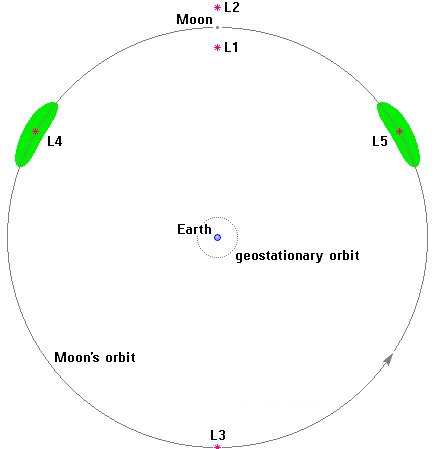
    One element in the last post was the Moonstalk, which would extend from the lunar surface to the Lagrange points L1 and L2.   Since that last post,  I have learned about LFTRs, which could supply power from the lunar surface up to L1 and back down again toward the surface.  This would enable a base to operate anywhere on the surface on the moon even while it is in the lunar night, which lasts two weeks.

    How?  There would be a LFTR at the polar region, which would beam microwave energy toward L1.  The L1 base would then convert that into electricity and back into microwave energy to beam back down to the surface.  The surface base would then collect the energy and use it.

    The L1 base could also beam energy to geostationary bases which could do the same toward the Earth, but not toward the surface, but towards collectors on VASIMR powered craft.  These craft could go to L1 or to other Lagrange points in order to supply them or to crew them.

    Meanwhile, back at the lunar base, which is being powered from the L1 base, will be building a Moonstalk infrastructure from the surface up toward L1.  Eventually, the two will be linked, so as to enable a crew and cargo easy access from the surface to L1 and indirectly, back to Earth.

    Transportation from L1 to the pole regions could be accomplished either by linking up to the L1 station, or by using Space Cannons to launch cargo back and forth.

    To start, you would need a base on L1.

    From L1, you would travel back and forth to the pole region selected and build a Moonbase there.

    You would begin to exploit the materials available there to support the Moonbase and to build a LFTR on the moon.  Once the LFTR is built, begin building a microwave transmitter for the Moonbase and a receiver and transmitter for the L1 station.

    After this is accomplished you will need one more receiver for the ground where you will begin building a Moonstalk.

    You will also need transmitter/receivers for the geostationary units orbiting the Earth.  These will be used to supply energy for the VASIMRs, which will be bringing supplies and crew back and forth between the Earth and L1.

    Prior to that, you will be using conventional rocketry.

    Once the VASIMRs are going, propellant needs will be vastly reduced.  VASIMR missions could also bring materials from the Earth, which will serve as an anchor for the Moonstalk.  Also, materials can be brought up from the lunar surface as well.  Once the Moonstalk is built, the final piece is to connect all the pieces together with the Space Cannon.

    Once all this is in place, you can start building your second Moonstalk at L2, on the back side of the moon.

    You could also build a nuclear thermal powered rocket which would never land on any planetary surface.  It could dock at L2 only, so as to always be away from the Earth, and never pose any radiation hazard towards Earth.

    L2 is the gateway to the solar system.  Once you have L2 constructed and the nuclear thermal rocket constructed, plus all the other materials in place, you will need only incidental support from the Earth.  The moon could supply most of its own needs, plus it could begin to support the outward push to the planets.

    Thursday, August 11, 2011

    O'Neill: Ch VIII,IX

    Chapter eight discusses the nuts and bolts of the first colony.  It will require a base on the moon, and a mass driver.  It would have taken six years.  The cost figures calculated are based upon Shuttle estimates, which were not in the cards.  Therefore, it couldn't have been economical.  It would have required an extra heavy lift vehicle to be constructed. That didn't happen, and still hasn't happened.

    Chapter nine discusses space solar power as an economic activity for the colony.  It was not to be, and for the same reason- which was launching costs.  Interestingly enough, O'Neill doesn't discuss how to solve this problem.  I think he assumed that the Shuttle would do that, but as we all know now, it didn't happen that way.

    This chapter also discusses his ideas for a propulsion based up lunar dust as a reaction mass.  I can't say that I like that idea at all.

    Oddly enough, he doesn't seem to making an economical case for building one of these things.  Even if his assumptions were correct, which they weren't, this doesn't make enough sense to me.

    He does make a case for his colonies to perform science.  Would a government be willing to support such large colonies for primarily scientific reasons?

    Self preservation of the species was also mentioned. If that is the goal, it can be done more cheaply.

    Wednesday, August 3, 2011

    The Morning Summary, 8/3

    Well, it is time to move on from this political stuff, now that the budget battle is over. As you may have noted, I have begun writing a little more about space. It so happens that on Next Big Future yesterday, there was a write up about thorium. Thorium is present in significant quantities on the moon, and to mine and process it should be much easier than uranium.

    In addition, a nuclear thermal rocket system could be employed on the moon for lunar transport.  The nuclear energy would come from thorium.   I have an idea for a lunar transportation rocket that would employ some concepts that I've read about with respect to the space cannon- John Hunter's concept.   Supplies could be sent from one location to another on the moon this way.

    I'll be writing more about this today, stay tuned.

    Update:  Just a few moments later...

    Kirk Sorensen's new Forbes blog is linked from that Next Big Future post.  I want to put it on the sidebar here because I think it is important for this idea that I'm cooking up.

    Update:

    I've been reading Sorensen's blog on Forbes.  I noted that 1 megawatt hour of electricity is worth only 40 dollars.  It would appear that energy is cheap, maybe too cheap to export to Earth.  That was my idea that I posted in the comment section of Next Big Future's Sorensen post.

    Running the numbers on what you would need in terms of power output, it would take at least 3 gigawatt power stations to generate each billion dollars in revenue.  That's a lot of power.  Not only that, some of that revenue has to finance the station itself.  The profit off of selling the power at 40 dollars per megawatt hour would be much less.  Therefore, you would need more than 3 power stations.

    Looking at it that way, you couldn't make it profitable.  However, not all hope is lost.  The key here is the energy production that is possible.  It could still power activities on the moon, which will make it self sustaining.  That is ultimately the idea.

    Update:

    Since beaming the energy from the lunar surface isn't that profitable, what else could you do?  I got an idea to beam power to a VASIMR so that it could do cis lunar missions.  The amount of energy that could be beamed to VASIMR could be orders of magnitude greater than could be developed with solar power.  That would make it much more powerful and faster so that it could transit the Earth Moon system on a frequent basis.

    This will be the last update to this post.  I will set up another post and continue from there.

    Sunday, July 10, 2011

    Moonbase continued

    Having trouble with Blogger again.  It won't let me update the previous post.  If it looks a little rough, that's why.

    Correction therefore here:  if each piece of the outer rim is 500 ft, then for a 1 mile in diameter torus, you would need more than 3 miles to do the job.  This means 15624 feet.  Dividing this by 500 gives 31 pieces.  It so happens that the picture of the bicycle tire shows about that many spokes.  So each piece could be connected to the hub by 1 spoke.

    This also means that you would need to launch each piece with a connecter to the hub and one at each end so that they can be connected together.  If they use a 16 inch "space cannon", the connectors between will be limited to no bigger than that.   Enough room for a man to go through?  Maybe barely.  Each would be like an airlock, so that it would preserve the air pressure inside.  Not real comfy, but livable, with 500 feet of space inside.

    Mass driver at Moonbase

    I ran the numbers with the artificial gravity equation, which I discussed here. You can reach orbital velocity from the Moon with a racetrack set up of diameter of two miles, with an RPM of about 10. That means that it circles the track every six seconds or so and goes a little over 6 miles. Approx 1 mile per sec. The number of g's would probably be too high, but I could possibly calculate that from the lunar gravitation constant.

    substituting lunar gravitation constant in upper equation


    I don't know if that is valid, but for the numbers above the "g" force would be ??? Actually, the number got larger for some reason. One would think otherwise. In the original equation, it would be over 160 g's. That would be too much for people.

    On second thought, a racetrack setup like this may be unrealistic. Perhaps you could set up a "space cannon" type gizmo in order to move stuff around on the moon, or into orbit. Those were tested at hypersonic speeds on Earth already.  I wonder if you could build one that would obtain orbital velocity?

    Actually, the ground test mentioned here would achieve escape velocity from the Moon.

    How could you build something comparable on the Moon? You could load one of these on a space craft that could land on the lunar surface. It would have to be constructed in place and it may need to use materials obtained from the Moon itself. Or, if it couldn't be obtained from the Moon itself, the raw materials could come from the Earth, and processed on the Moon.

    By processing, I mean, taking say, basic steel, or aluminum, or some other metal that could be easily transported to the lunar surface. It would then be melted down and cast into a the appropriate shape desired.

    Here's an idea that I've considered in connection to landing on the Moon without incurring as large of a mass penalty. You could use solid metals as reaction mass for your descent. The descent should be nearly vertical over the landing area so as to "recycle" the metals later after landing.

    You would heat a gas, probably hydrogen hot enough that it could push a larger mass of metal downward with considerable velocity towards the lunar surface. The opposite reaction is according to Newton's laws, and it would slow down the descent as it would with a hot gas. The difference is that the gas dissipates, but the metal remains to be collected later.

    Several tons could be expelled in such a manner. Although the final descent should be with a conventional engine setup. This could be considered a dual staged descent.

    Update:

    The discussion of a space gun as an example above mentions a 16 inch 100 caliber Navy gun.  Here is a discussion of how big such a gun would be in length.   The calculation would be 16 inches x 100 = 1600 inches long.   133 feet!  The slug weighed in at 180 Kg.  ( nearly 400 lbs).

    Now, in order to build a O'Neil colony in space with lunar materials, you would need to somehow break down the pieces to that size and weight, and fire them many, many times.  You may want to aim at L4 or L5 Lagrange point in the Earth Moon system.  One proposition would be to load up a module of carbon nanotube superstructure at a time.  The superstructure would be able to be inflated when it arrives the Lagrange point.  Subsequent firings could place stuff inside the superstructure to build it from the inside.

    An estimate to its size?  Maybe 500 ft to 1000 ft cylinders that would fit end to end so that it could make a torus, or donut shape.  Or perhaps, the torus could be made with the carbon nanotubes making up the foundation of subsequent construction.  It would be set up in a ring 1 mile in diameter, consisting of 500 to 1000 ft at a time.  This would mean 3 to 6 main pieces connected together to form the basic structure.

    It might look like a bicycle tire, with the carbon nanotubes making up the rim.  You would then build inwards toward the hub with "spokes" to fit towards the middle towards the hub.   The spokes could be tethers that fit into a central hub and extended out towards the periphery where the carbon nanotube "tube" is.  Like the bicycle tire.
    http://www.everybicycletire.com/
    Pardon me for the amateurish example above.  It is a common ordinary bicycle tire from an advertisement on a webpage.  It will serve as an illustration of what I propose.  So far, I have describe the outer ring of carbon nanotubes which are inflated and connected to each other to form the torus.  The spokes are connected to a hub in the middle so that the hub and the outer rim are connected.   The habitable part will be between the rim and the spoke with a connecting point to the rim on one side and the spoke on the other.

    Now, getting the spokes and the hub into position with the space gun may be a challenge.  But since they are tethers, they may be coiled inside a container.

    By the way, I am making this stuff up as I go along.  This is like thinking aloud.  The problem I see is that the carbon nanotube that forms the rim may be desirable a habitable space, but since they have to be shot up separately and connected together, they won't be as open as you may like.  This may give something of a confining feel to the place.

    Thursday, July 7, 2011

    Why Colonize Space?

    For the sake of argument, let say there aren't any rational reasons to colonize space.   Let's reconsider that in another light by making an analogy.   What if you could compare an off world colony to a child?   What if you could consider the Earth having a son or daughter world that could be born and raised up until it can go out on its own?   Let's consider if that is possible.   Then it can be considered as a choice to do or not do.

    Now for the matter of whether or not it could be done.  Let's start with the Moon.  We now know that there is water on the Moon.  There may be other "volatiles" that could be useful in life support.  In addition to all this, there is abundant matter on its surface.   With some effort and expense, a permanent lunar colony could be started which could do...  what?

    I think that it should immediately put to the task of creating an artificial world that O'Neil envisioned.   Getting material from the Moon to space is a lot easier from the Moon itself than from directly from Earth.  The advantage is in the same vein as it would be to put a colony on the Moon.  It is easy to escape the Moon, and easier still to escape an O'Neil colony.  From an O'Neil colony, it could then be possible to begin colonizing the rest of the solar system.

    The O'Neil colony would be the ultimate goal, but in the meantime, we have to fix up a Moonbase. We need access to its resources, which could consists not only of its volatiles, but also of thorium, which can be used as a source of energy.  Why thorium?  Assuming that fusion is still a long ways off, we know that thorium can be used with today's technology.  Therefore, the second task on the Moon, after mining it for its volatiles, would be to mine it for its thorium.  Now, let's inventory the lunar capabilities.  You have a life support system in place which, with an energy source, can begin major processing of lunar ores.  In short, you can start making stuff for your O'Neil colony.  In addition, with an energy source like thorium, you can have a propulsion system that can get you off the surface.

    You need a transportation system on the Moon in order to move materials around on its surface.  This can be achieved with mass drivers, or some similar technology.  In this manner, a lunar trading system can be emplaced, which could move materials from where there are to where they are needed.   Now, you have a life support system, an energy production system, a transportation system, and an economic system.  It is beginning to look like a society that can begin to support itself.  Not to mention, it can cooperate with Earth and create another O'Neil colony in space.  In this manner, the colonies begin to act like an organism that replicates itself.

    And that is the whole idea.  Life doesn't have to be "rational" in the sense of always being economical.  If you want a child, for example, it isn't so you can make money off the child.  You want a child to pass along what you know to the next generations to follow.  It is like a bond from the past towards the future.  A society that no longer cares about this no longer cares about continuing to exist.  What kind of world do we want to leave our progeny?  A world in which can be ever increasing and expanding, or one in which is always contracting and dying off?  A colony would be an investment in our own future.  Even more, it can be our guarantee of even having a future.   We may not benefit directly ourselves, but we can be assured that those following us will have a place in the sun.

    Sunday, May 8, 2011

    Eve wrap, 5/8

    Busy day posting. This is the 12th post. For a long time, I averaged just 3 a day. Here's the list of posts.
    Looking back on the day, it began as a political day, but ended as a space day.  By the way, while I was thinking up my next post, I read about Quicklaunch, better known for the Cannon to the Planets idea by John Hunter.  I was wondering how all that turned out.

    Anyway, it's time to shut down for another day.  I'll put in a video for your amusement.  Thanks for coming by.

    Saturday, January 1, 2011

    More on the Space Cannon

    I could have been a bit hasty in saying that the Space Cannon concept is around the corner.  So, I spent some time today on the subject to see if anything there looks different this time around.

    Here's a wikepedia entry on the man, John Hunter, who presented the video which I had linked to in the earlier post.  There are a few more links about the man from the wikipedia entry to check out, but information is sketchy.

    This presentation is a little over a year old, so I am looking for signs of progress since that time.  He is on a 8 year time table according to the presentation.  So, it has been a year.  What has been done in the past year?  It's a bit hard to tell from where I am standing.  This comment is the most recent I can find.  It doesn't tell anything.  In fact, it isn't even relevant.

    In his presentation, he admits that he is not a rocket scientist, but his concept will require one.  That's because the projectile that he plans to put into orbit with his space gun will need a rocket to get into orbit.  Also, he says in his presentation that he will meet some venture capitalists for funding.  I wonder how that went.

    If, by any chance, that things went well, sometime in the next few years, there could be an IPO for his company.  A lot will have to happen before that can occur, however.  For one thing, he will need a customer.  Most likely, even at this point, his only customer is likely to be NASA.  Maybe some private companies can use this service,  however.  I am not well versed on the subject enough to make a guess on the probability of that.  If he can secure one big customer, like NASA, he could be on his way.

    So, in the end, his problem is that he could have a technology that needs a customer.  Without a mission from NASA or a private customer with a need for his service, it won't matter if his idea will work or not.

    Now for a dash of speculation.  What if you were to employ this concept on the Moon?  It would be a way to avoid using much propellant.  And it would be better than a mass driver.  That, according to Hunter.  The trick would be in getting the gun up there.  But a lunar version of a gun like this wouldn't have to be nearly as powerful.

    If a version of this gun were to be used to move lunar volatiles to the equatorial region so that a Moonstalk could be built, that would be interesting, yes?