The usual hair raising stuff from Chris. But these are strange times. It is a shock that so much of what he writes turns out to be true. In an earlier time, if somebody wrote stuff like this, they might get locked up. ( not really) Anyway, if you are interested in reading more, a link to his website is in the products page. Go there and click on the link if you want to subscribe. It requires a subscription.
Gold and silver settle a bit
Gold and silver caution
USD stuff
Our crash alerts
If there was a huge crash in stocks, would you be intact or not?
Euro
CAD AUD
Speculation
Don’t be seduced
Country living in a crisis
Could the US and West actually face economic collapse and food panics?
Mid East

Al Fin: "Cowboy Commentary", aka "Eat your veggies" The Flag banner is posted in order to defy those who would make patriotic symbols illegal or disreputable.
Sunday, May 15, 2011

Solar plane makes maiden international flight
Stories like this sadden me. There are much more worthy causes than this- and I don't mean to knock solar power.
What about the Deltoid Pumpkin Seed? This was a combination airship/airplane which was called an aerobody in the book . It so happens that a prototype has a series of successful flights but never could get any funding for development of the concept.
The aircraft could take off and land like a plane, but it had the lifting capacities of a large airship. It seems to me that a aircraft like this could be fitted with solar panels and an electric engine. It could carry freight and passengers and wouldn't use fossil fuels. No, it wouldn't be fast, but it would be cheap. Perhaps passenger service is not the best idea? Then use it for freight. It could carry plenty.
The plane mentioned in this article doesn't have any uses that I can find. Yet it got hundreds of millions of dollars in funding. What a pity.
Update:
Here's video of it. Why are these people so impressed with this thing? It doesn't do anything.
What about the Deltoid Pumpkin Seed? This was a combination airship/airplane which was called an aerobody in the book
. It so happens that a prototype has a series of successful flights but never could get any funding for development of the concept.The aircraft could take off and land like a plane, but it had the lifting capacities of a large airship. It seems to me that a aircraft like this could be fitted with solar panels and an electric engine. It could carry freight and passengers and wouldn't use fossil fuels. No, it wouldn't be fast, but it would be cheap. Perhaps passenger service is not the best idea? Then use it for freight. It could carry plenty.
The plane mentioned in this article doesn't have any uses that I can find. Yet it got hundreds of millions of dollars in funding. What a pity.
Update:
Here's video of it. Why are these people so impressed with this thing? It doesn't do anything.
To Mars? Maybe. To the stars? Probably not.
This may seem like a confession if you haven't read all my stuff. I don't know that much about physics. I would really like Focus Fusion to work soon and have it power a spacecraft to anywhere in the solar system. But I haven't the foggiest notion of how this might be done.
I just spent some time looking over a few things, such as a pdf file of focus fusion. I don't understand what they wrote there, to be honest.
So, it is hard to say where they are on this and what they still need to do. My guess is that they need to have a way to pulse that thing a lot. I haven't seen enough about how that might be done. Inasmuch as I would have liked to see this powering a rocket, I have little to go on that will show how this might be done.
And so all this amounts to speculation. More than likely, if there's a fusion device that becomes net energy soon, the path forward for rockets is something like VASIMR. VASIMR needs a powerful energy source. If one can be found, it can take a spacecraft to Mars quickly enough.
Now if we were to speculate further, let's say the Rossi Focardi device can be put on a rocket. If that is possible, you could have a device that will get you to Mars. It would simply be a matter of testing VASIMR, which will happen soon. The next step could be to integrate that device with VASIMR so that it will have the power it needs to get to Mars quickly. This looks like the quickest path other than a fission rocket, like NERVA was.
This is nuts
Look at how long of a line to a new burger outfit called In N Out Burger. That is, it is new to Texas. Their burgers have to be awfully good for me to wait in a line this long. Frankly, NO burger is that good. You could wait hours in a line that long. You gotta be kidding me!
Fusion Taking Focus- Fall 2010 Update
This will be included in my new sidebar entry- fusion propulsion- because it may be possible for it to become a spinoff from the net energy research for focus fusion. It doesn't appear to be the case for the moment, though. I don't know the reason for this. There could be a reason why it can't be, but if that is the case, I'm unaware of it.
This presentation has four parts. The first part is embedded here. You can follow the rest of the presentation by following the links provided.
Update:
I think the answer to the question of why it can't be a propulsion device is that it may require a lot of technical advances not yet achieved. ( An engineering problem)
Here is a screen shot of the proof of fusion- the bubbles are caused by neutrons. The neutrons are captured in this way, which shows that fusion did indeed occur.

Update:
Here's another pic, actually two that I have put together. One is from the animation of the dense plasma focus and the other is an actual pic of the process in process. This shows how the actual filaments are being formed during the fusion process- before the plasmoid is formed. The filaments form first, then they twist into tighter and tighter ball or plasmoid.


The actual plasmoid is shown below.

This presentation has four parts. The first part is embedded here. You can follow the rest of the presentation by following the links provided.
Update:
I think the answer to the question of why it can't be a propulsion device is that it may require a lot of technical advances not yet achieved. ( An engineering problem)
Here is a screen shot of the proof of fusion- the bubbles are caused by neutrons. The neutrons are captured in this way, which shows that fusion did indeed occur.

Update:
Here's another pic, actually two that I have put together. One is from the animation of the dense plasma focus and the other is an actual pic of the process in process. This shows how the actual filaments are being formed during the fusion process- before the plasmoid is formed. The filaments form first, then they twist into tighter and tighter ball or plasmoid.
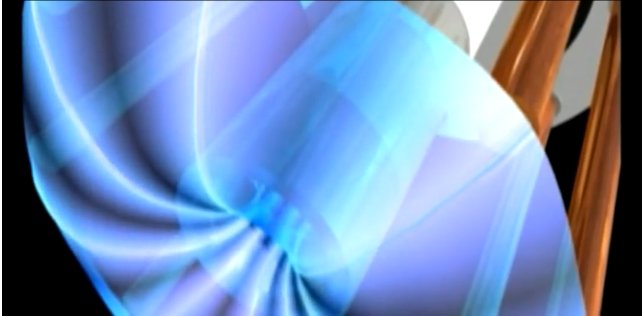

The actual plasmoid is shown below.

New Sidebar Entry- Fusion Propulsion
I think I'll call it fusion propulsion. Why? Of all the things I've posted, this is the one thing that could be a real difference maker. Not that it will be, but it could be.
Fusion propulsion can solve a few problems with deep space travel. For one thing, it can be faster. If space travel can be sped up significantly, some of the other issues can be minimized. Such as microgravity, for one. If a spacecraft can get to Mars in days instead of months, it will be a much simplified task. Not just with microgravity, but with a number of other issues, such as life support and radiation. The shorter the mission is in terms of time, the greater the probability that a problem won't risk the mission or the crew.
I will go back through all my posts on the subject, and attach the new label to it. Anybody interested can click on that label and pull up all the posts that I've written about it.
Morn. Summ. 5/15


This got me to thinking about something that I've been focusing on since I started blogging regularly last September. The idea of space colonization and how it may be the answer to a lot of problems here on the ground. People don't believe that because it's been drummed into their heads that it is impossible. For one thing, it costs too much. But not necessarily. Costs can be brought down. If you start with a belief that it can't be done, why, you are never wrong. It can't be done if you don't try. Somebody has to, but very few people outside of the space community seem interested in it.
You do need money to do the job though. How to do it? Get some venture capital? But that is not likely because they want a payoff in 3 to 7 years. That may be too far off. You are going to need more time than that. With the above paragraph, it would appear that politicians will not be interested. That leaves you with little to work with. You have to find somebody with deep pockets who will fund it, but who? And how? And why? The why part can be answered if you had a plan and you can get somebody with money to fund the plan.
I better post now since it is 6 in the morning local time. I will return to this today. Keep tuned.
Subscribe to:
Posts (Atom)